

To gather a pen and write to IPSO is to rile the ghost of Audre Lorde. Can there be a more brutal demonstration of the limits of the Master’s Tools than IPSO - which depends for its very existence on the newspapers it purports to regulate?
Nevertheless, the shamelessness, the racism and the dishonesty of The Times demands some action and so, with apologies for trolling her magnificent spirit, I wrote to the Times, preparatory to an IPSO complaint.
Dear The Times,
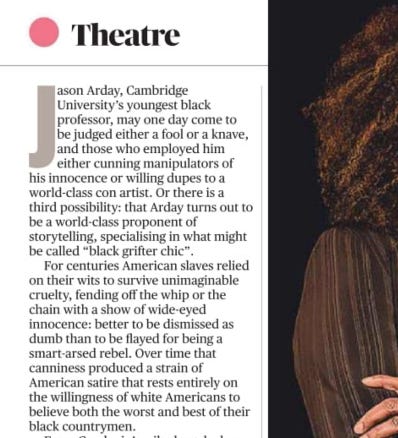
The print edition of the Sunday Times for 16 August 2026, two days after Professor Jason Arday’s death, carried an article by Trevor Phillips. The article was entitled “The lies that won a Pulitzer” and contained these paragraphs suggesting, once what we must assume Mr Phillips considered to be his fine writing is stripped away, that dishonesty (“black grifter chic”) is a mode of being that Black people learned during their enslavement and which, by some process undescribed, remains embedded in contemporary Blackness.
“Jason Arday, Cambridge University’s youngest black professor, may one day come to be judged either a fool or a knave, and those who employed him either cunning manipulators of his innocence or willing dupes to a world-class con artist. Or there is a third possibility: that Arday turns out to be a world-class proponent of storytelling, specialising in what might be called “black grifter chic”.
“For centuries American slaves relied on their wits to survive unimaginable cruelty, fending off the whip or the chain with a show of wide-eyed innocence: better to be dismissed as dumb than to be flayed for being a smart-arsed rebel. Over time that canniness produced a strain of American satire that rests entirely on the willingness of white Americans to believe both the worst and best of their black countrymen.”
The online version of that piece, published on a weekend so in The Times and hence why my complaint is to The Times, is (now) entitled “The fake news that won a Pulitzer” and is time stamped 12 August 2026 4:00pm. Those paragraphs now state:
“The tragic denouement of the tale of Jason Arday, Cambridge University’s youngest black professor, ensures that his story will continue to be debated for decades to come. He may one day come to be judged either a fool or a knave, and those who employed him either cunning manipulators of his innocence or willing dupes.
“But either way, his death will be one more chapter in a grim litany of the consequences of the transatlantic trade in black bodies. For centuries American slaves relied on their wits to survive unimaginable cruelty, often fending off the whip or the chain with a show of wide-eyed innocence: better to be dismissed as dumb than to be flayed for being a rebel. Over time that canniness produced a strain of American satire that rests entirely on the willingness of white Americans to believe both the worst and best of their black countrymen, whether or not they were the descendants of slaves.”
As you will note, the first and second paragraphs have been substantially rewritten, in particular, (1) to remove the reference to “black grifter chic” (2) the suggestion that dishonesty is embedded in contemporary Blackness in consequence of Black enslavement and (3) to refer to Professor Arday’s death (the “tragic denouement”) in an article purportedly dated several days before he actually died.
The electronic version contains no reference to the fact that The Times retrospectively rewrote the piece, no doubt because Professor Arday’s death rendered the piece awkward, even to a man with your editor Tony Gallagher’s elastic moral frame.
I should note that this is not the first time the Times or Sunday Times has rewritten the record to cover up its racism. On 18 April 2021, the print edition of the Sunday Times carried a column stating, of the then Monarch on the death of Prince Phillip:
“On this gloriously sunny but most solemn of Saturday afternoons, she was not just a monarch being scrutinised on television around the world but a woman saying goodbye to the one she loved.
“To her subjects, Prince Philip was the longest-serving Royal consort in British history - an often crotchety figure, offending people with gaffes about slitty eyes, even if secretly we rather enjoyed them.”
In the online version, again with no note, The Sunday Times omitted the words “about slitty eyes”.
I do not write to you to assert that your racism engages the IPSO code. A decision that it did would cause many or most of the newspapers who fund IPSO to withdraw their funding and would likely lead to IPSO’s collapse.
However, it is also simply dishonest of The Times to rewrite the record in the hope that history smiles more favourably on its coverage, without admitting it has done so and in those circumstances “Clause 1-Accuracy” is engaged.
i) The Press must take care not to publish inaccurate, misleading or distorted information or images, including headlines not supported by the text.
ii) A significant inaccuracy, misleading statement or distortion must be corrected, promptly and with due prominence, and — where appropriate — an apology published. In cases involving IPSO, due prominence should be as required by the regulator.
I invite you so to find.
Yours faithfully,
Jolyon Maugham KC
Thank you for calling out The Times. Much appreciated
Glad you called them out. But that‘s not all in their piece that is reprehensible and cruel. This jumped out :“He may one day come to be judged either a fool or a knave“
So they airily pass judgement, no evidence required or considered. And no understanding that they are smugly participating in what is effectively a mob lynching.